Barbed Wire Fence Calculator
Enter the fence length, the number of strands and the post spacing to see how many rolls, posts and braces the fence needs.
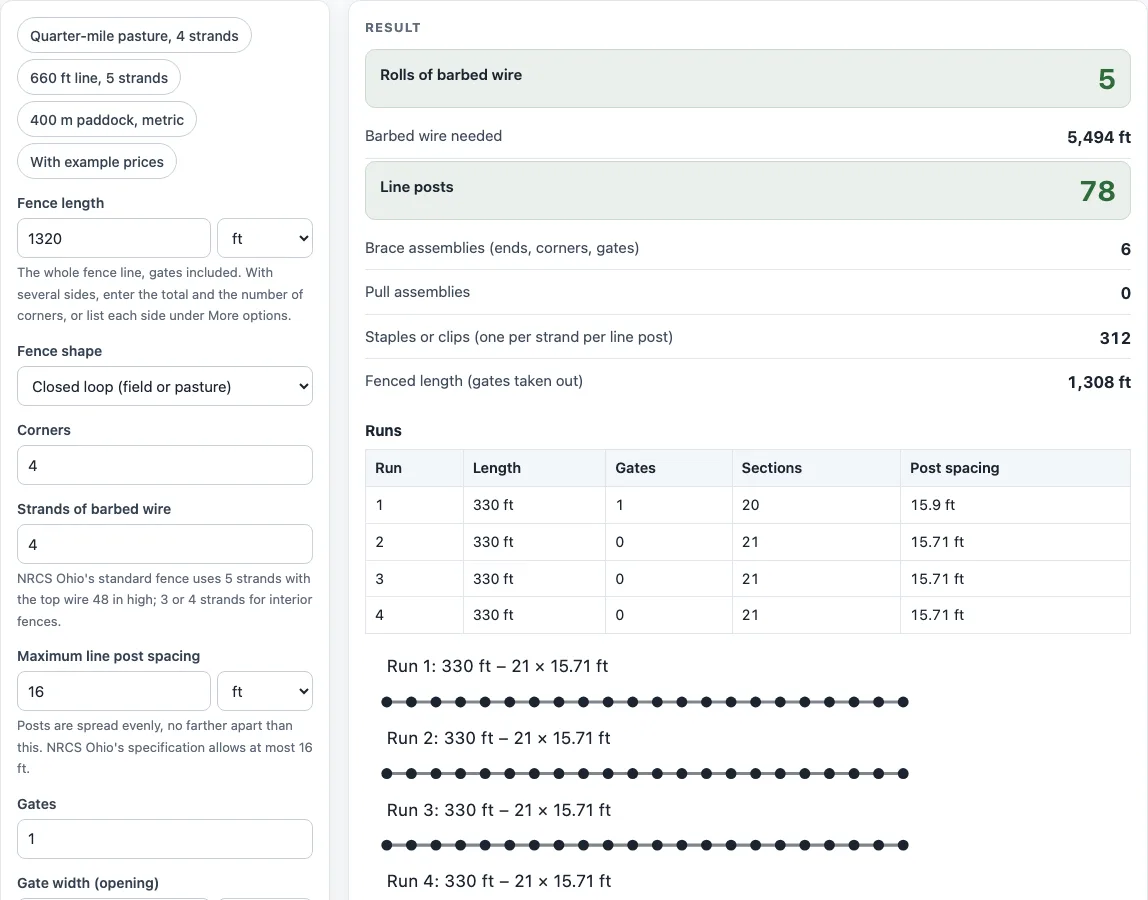
How to use the Barbed Wire Fence Calculator
- Type the Fence length in feet or metres, gates included. For several sides, enter the total and the number of corners.
- Choose a Fence shape: Closed loop (field or pasture), Open line with corners, or Separate straight runs, and enter the number of Corners.
- Enter the Strands of barbed wire (1 to 10).
- Enter the Maximum line post spacing. Posts are spread evenly and never farther apart than this value.
- Enter the Gates and the Gate width (opening).
- Open More options to check Wire per roll against your supplier’s roll, set Extra wire (%) (0 gives the exact line length), add Wire stays per section, switch Add pull assemblies every 660 ft (non-high-tensile wire) on or off, or list each side in Side lengths (optional).
- Also under More options, choose a Currency and type Price per roll, Price per line post, Price per brace assembly and Price per gate to get the Material cost (your prices).
- Read the result lines and the plan of the runs, and check How it was calculated for each step with your numbers.
The four example buttons at the top of the form fill in realistic cases. Use Reset to return to the starting example. Under the result, Copy result copies the figures, Copy link keeps all your inputs in the page address so the same result reopens later, and Print / save as PDF prints the inputs, result, calculation steps and date.
How many rolls of barbed wire do I need for a fence?
Divide the total wire needed by the length of one roll, then round up to a whole roll. The tool does this using the Wire per roll value you enter. The usual roll for 12.5-gauge barbed wire is 1,320 ft (80 rods), but check your supplier’s roll.
How is the barbed wire length calculated?
The wire needed equals the number of strands multiplied by the fence length without the gate openings. Add the extra percentage on top for wraps at the braces, splices and waste. Gate openings are removed first, so a 12 ft gate on a 1,320 ft fence means 1,308 ft of line is wired.
How many strands of barbed wire should a fence have?
A standard NRCS Ohio fence uses 5 strands, with the top wire 48 in above the ground. Three or four strands are used for interior fences. Other states and purposes use other counts, so enter the number you plan to build.
How far apart should barbed wire fence posts be?
Line posts are spread evenly, and they should not be farther apart than your maximum spacing. NRCS Ohio allows at most 16 ft between line posts. Shorter spacing supports the wire better, and the tool warns you if your value is farther apart than 16 ft.
How do you estimate the cost of a barbed wire fence?
Multiply each material count by its price, then add the totals. The tool multiplies rolls, line posts, brace assemblies and gates by the prices you type, because it does not assume prices. Staples or clips are one per strand at each line post, so they are counted in the results but not priced.
Sources
- NRCS Ohio Construction Specification 382, Standard Barb Wire Fence (Aug 2016) — 5 strands with the top wire at 48 in (3–4 for interior fences), strand spacing, line posts at most 16 ft apart, brace assemblies at corners, ends, gates and pulls, pull assemblies at most every 660 ft. One state’s specification: other states and uses differ.
- Bekaert standard 12.5 ga 4-point barbed wire — 1,320 ft rolls (80 rods). Checked October 2026.
Worked examples
| Input | Result |
|---|---|
| 1320 ft, 4 strands, posts at most 16 ft apart | 5 rolls (5,493.6 ft), 78 line posts, 6 brace assemblies |
| 660 ft, 5 strands, posts at most 16 ft apart | 3 rolls (3,465 ft), 41 line posts, 2 brace assemblies |
| 400 m, 3 strands, posts at most 4 m apart | 4 rolls (1,247.4 m), 94 line posts, 6 brace assemblies |
| 1320 ft, 4 strands, posts at most 16 ft apart | 5 rolls (5,493.6 ft), 78 line posts, 6 brace assemblies, material $1,646.95 |
Calculated by the tool above with these values.
Frequently asked questions
Does the calculator include gates in the wire length?
Yes, the Fence length should include the gates, and the tool then removes the gate openings from the wired length. The gate posts are counted as brace assemblies, and each gate has its own price field.
Why does the tool say the gates take up the whole fence line?
The gate widths you entered equal or exceed the fence length, so no wire is left to stretch. Reduce the gate widths or check the fence length.
What does the warning about extra wire mean?
The tool shows a warning when the extra wire percentage is high. Check the fence length and percentage before ordering, because a large allowance can add a roll you do not need.
Can I use the results for a quote or job sheet?
Yes. You may use the results in commercial work, such as quotes, material lists and job sheets, with no attribution. Confirm post depth, spacing and openings with local codes and the manufacturer’s instructions first.
How many staples do I need for a barbed wire fence?
One staple (or clip on a steel post) per strand at every line post. The tool multiplies the strands by the line posts; for 4 strands and 78 line posts that is 312. Brace posts are fastened differently, so add a few for them.
Related tools
- Fence post depth calculator — how deep to set posts and the post length to buy.
- Fence post spacing calculator — the number of posts and an equal spacing.
- Linear feet fence calculator — the fence line of your yard in feet, yards and metres.
- Chain link fence calculator — the full chain link materials list.
- Fence cost calculator — the materials list and total cost with your local prices.
- Fence post concrete calculator — concrete bags per post hole.
- Electric fence energizer calculator — output joules for the length of an electric fence.