Bollard Spacing Calculator
Enter the width of the opening and your largest allowed gap to get the number of bollards and their equal spacing.
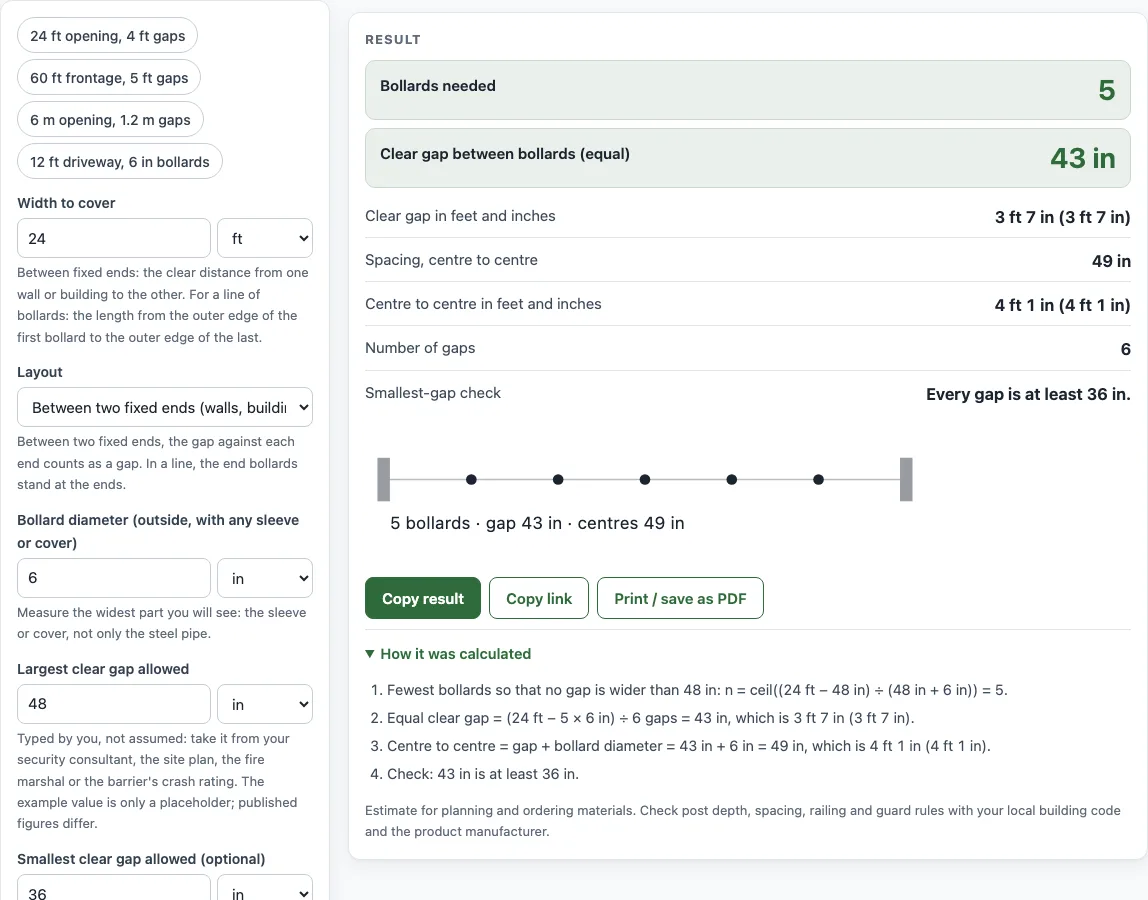
How to use the Bollard Spacing Calculator
- Enter the Width to cover. Between two fixed ends this is the clear distance from wall to wall; for a line of bollards it is the length from the outer edge of the first to the outer edge of the last.
- Choose the Layout: Between two fixed ends (walls, buildings, curbs), where the gap against each end counts, or A line with a bollard at each end.
- Enter the Bollard diameter. Use the outside size with any sleeve or cover, because that is what a person or vehicle meets.
- Enter the Largest clear gap allowed. The form starts with 48 in as a placeholder only; use your project’s own requirement.
- Optionally change the Smallest clear gap allowed. It starts at 36 in, the minimum clear width of a walking route in the ADA Standards. Enter 0 to skip the check.
- Read Bollards needed, Clear gap between bollards (equal) and Spacing, centre to centre, and check the drawing.
The example buttons fill in cases such as 24 ft opening, 4 ft gaps or 60 ft frontage, 5 ft gaps. Reset restores the start. Copy result copies the figures, Copy link keeps your inputs in the page address, and Print / save as PDF prints the inputs, the result, the steps and the date.
How do you calculate bollard spacing?
With a fixed wall or building at each end, n bollards leave n + 1 gaps, and each equal gap is the width minus the bollard diameters, divided by n + 1. The fewest bollards that keep every gap within your limit G is n = (W − G) ÷ (G + d), rounded up, where W is the width and d the diameter. In a line with a bollard at each end, n bollards leave n − 1 gaps, and n = (W + G) ÷ (G + d), rounded up. Centre-to-centre spacing is the clear gap plus the diameter. For a 24 ft opening, 6 in bollards and a 48 in limit, n = (288 − 48) ÷ 54 = 4.4, rounded up to 5 bollards. They leave 6 gaps of (288 − 30) ÷ 6 = 43 in, which is 49 in centre to centre.
How far apart should bollards be?
There is no single distance. The right gap depends on what the bollards must stop. For pedestrians, the 2010 ADA Standards require a walking route to be at least 36 in wide, and that width cannot be reduced by bollards or other elements; it may narrow to 32 in at a point no longer than 24 in. To keep vehicles out, the gap must be smaller than the narrowest vehicle you want to stop, and published figures differ. One bollard maker, Barrier1 Systems, gives 3 to 4 ft on centre (2 to 3 ft clear) for stopping all standard vehicles and 4 to 5 ft on centre for passenger cars, and says crash-rated bollards keep their rating at roughly 3.9 to 5.5 ft on centre. Another vendor may quote different values, so use the figure in your site plan, the barrier’s test report or your local authority’s rule. A fire lane or emergency route may need a wider gap.
Why measure the clear gap and not just the centres?
The 36 in rule applies to the clear opening between the bollards, not to the distance between their centres. A 4 ft centre spacing with 6 in bollards leaves a 3 ft 6 in clear gap. Sleeves, covers and decorative bands add to the diameter, so measure the widest part. This tool reports both numbers.
Sources
- U.S. Access Board, ADA Standards guide, Chapter 4: Accessible Routes (read 17 Oct 2026) — clear width of at least 36 in, 32 in at a point for up to 24 in, not reduced by any element.
- Barrier1 Systems, Distance Between Bollards (vendor guide, read 17 Oct 2026) — ranges of 3 to 8 ft on centre by use, with vehicle-stopping values and the crash-rating spacing quoted above. Vendor figures, not a code.
- Count, gap and centre spacing = geometry on the numbers you enter; the largest gap is your input.
Worked examples
| Input | Result |
|---|---|
| 24 ft, Between two fixed ends (walls, buildings, curbs), gap at most 48 in | 5 bollards, 43 in clear, 49 in centre to centre |
| 60 ft, A line with a bollard at each end, gap at most 5 ft | 12 bollards, 56.73 in clear, 64.73 in centre to centre |
| 6 m, Between two fixed ends (walls, buildings, curbs), gap at most 1.2 m | 4 bollards, 108 cm clear, 123 cm centre to centre |
Calculated by the tool above with these values.
Frequently asked questions
How far apart should bollards be placed?
It depends on the purpose. Many vendors quote about 3 to 5 ft on centre to stop vehicles, with a clear gap of at least 36 in where people must pass. Because the figures differ, enter the maximum gap your project requires and let the calculator find the count.
What is the ADA minimum distance between bollards?
The ADA Standards need a clear width of at least 36 in on an accessible route, and a bollard cannot reduce it. The clear width is measured between the faces of the bollards, so the centre spacing is larger than 36 in by one diameter.
How many bollards do I need for a driveway or storefront?
Measure the width, enter your bollard diameter and largest allowed gap, and choose between fixed ends or a line. For a 24 ft opening between two walls with 6 in bollards and a 48 in limit you need 5 bollards, spaced 49 in centre to centre.
Is centre-to-centre spacing the same as the gap?
No. The centre-to-centre distance is the clear gap plus one bollard diameter. A 6 in bollard at 49 in centres leaves a 43 in gap.
Does this meet the building code or a crash rating?
No. The tool does the geometry only. Crash ratings, foundations, utilities and fire access are set by your engineer, the manufacturer and the local authority, and the gap limits are your inputs.
Is my opening data uploaded anywhere?
No. The calculator runs in your browser and nothing you type is uploaded. It is free and needs no sign-up.
Related tools
- Fence post spacing calculator — posts and equal spacing along a fence run.
- Fence post depth calculator — how deep to set posts.
- Fence post concrete calculator — concrete bags per post hole.
- Baluster spacing calculator — equal gaps between balusters.
- Deck railing calculator — rail, posts and balusters for a deck.
- Security camera field of view calculator — how much of the area a camera covers.