Chain Link Fence Calculator (Materials List)
Enter the fence length, height, corners and gates to get the chain link materials list.
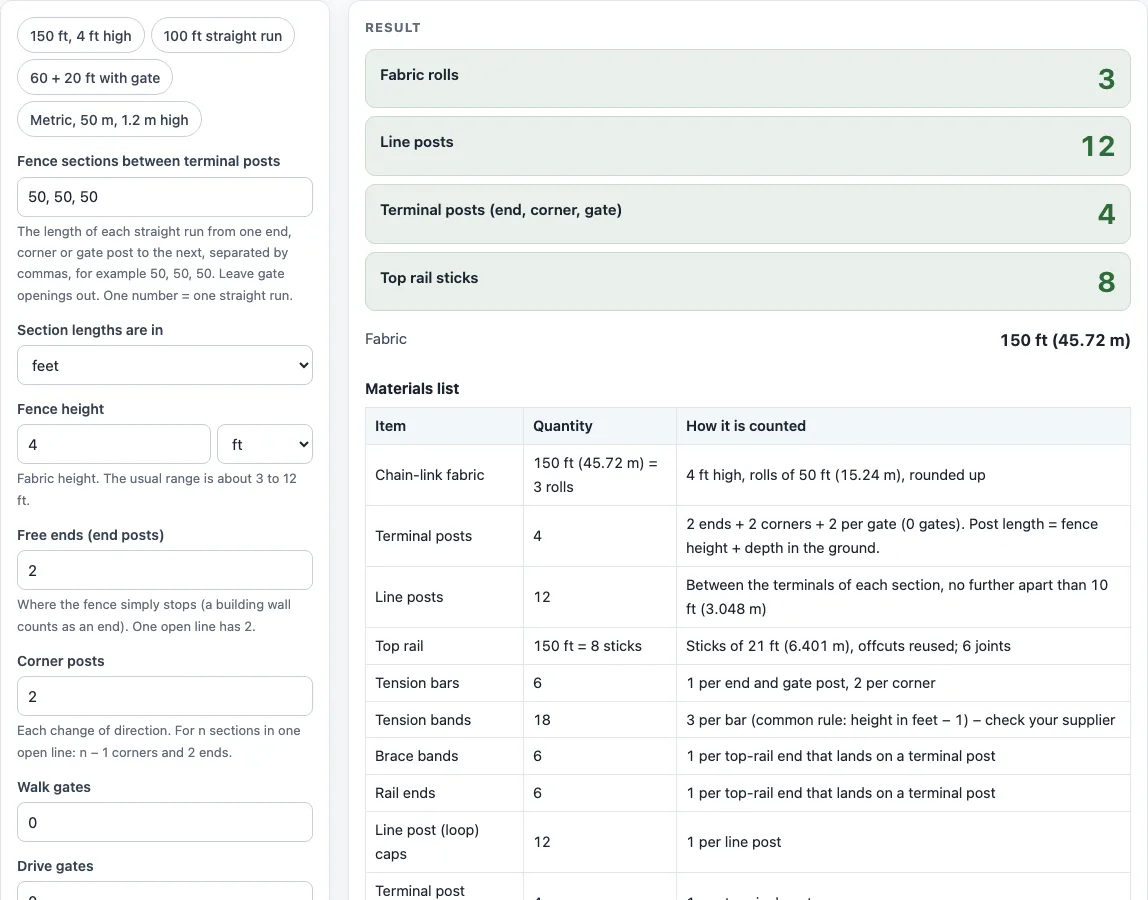
How to use the Chain Link Fence Calculator
- Type the straight runs in Fence sections between terminal posts, separated by commas, for example 50, 50, 50. Leave gate openings out. One number means one straight run.
- Set Section lengths are in to feet or metres.
- Enter the Fence height. The usual range is about 3 to 12 ft.
- Enter Free ends (end posts). One open line has 2.
- Enter Corner posts. For n sections in one open line, use n − 1.
- Enter Walk gates and Walk gate width, and Drive gates and Drive gate opening if you have them. Each gate adds 2 gate posts.
- Check Line post spacing (maximum), Fabric roll length, Top rail stick length, the two tie wire spacings and Tension bands per bar (optional). Change these only when your supplier or local rules say so.
- Read the result. If a warning appears, compare the section, end, corner and gate counts against your sketch before you order.
Use the example buttons at the top of the form to load a realistic case, such as 150 ft at 4 ft high or a metric 50 m job at 1.2 m high. The Reset button restores the starting example. Some fields sit under More options. Copy result copies the figures, Copy link keeps all your inputs in the page address, and Print / save as PDF prints the inputs, result, calculation steps and date.
How does a chain link fence calculator work out the fabric length?
Fabric length equals the fence length, with gate openings left out. The calculator adds your straight runs together, then divides by the roll length to count rolls.
For example, a 150 ft fence with 50 ft rolls needs 150 ÷ 50 = 3 rolls. The result is rounded up to a whole roll, because you cannot buy part of one. Fabric height comes from the fence height you enter, so a 4 ft fence uses 4 ft wide mesh.
How are posts, rails and fittings counted?
Posts follow from the shape of the fence. Terminal posts are the ends, corners and gate posts. An open line has 2 ends, one corner for each change of direction, and 2 gate posts for each gate. Line posts fill the spaces between terminal posts at the spacing you enter, which is commonly up to 10 ft.
Tension bars go at each end and gate post, and two go at each corner, because the fabric is stretched and ends there on both sides. Tension bands are counted per bar. The default is fence height in feet minus 1, so a 4 ft fence uses 3 bands per bar.
Top rail is the total length divided by the stick length, commonly 21 ft, and the sticks are joined end to end. Tie wires are counted from the spacing you enter, commonly every 12 in up each line post and every 24 in along the top rail. Each of these is a planning count. The How it was calculated list shows each step with your own numbers.
Sources
- Hawaii state specification 32 31 13, Chain Link Fences and Gates — line posts at intervals not exceeding 10 ft.
- Hoover Fence chain-link installation manual — tie wires every 24 in on the top rail and 12 in on line posts; Hialeah chain link fence detail (Florida Building Code 2224) — tension bands one less than the fence height in feet; Hoover top rail sleeves — 21 ft rail lengths; 4 ft × 50 ft fabric rolls are standard retail listings.
Worked examples
| Input | Result |
|---|---|
| 50, 50, 50 ft in sections, 4 ft high, 2 ends, 2 corners | 3 fabric roll(s), 12 line + 4 terminal posts, 8 rail stick(s) |
| 100 ft in sections, 5 ft high, 2 ends, 0 corners | 2 fabric roll(s), 9 line + 2 terminal posts, 5 rail stick(s) |
| 60, 20 ft in sections, 6 ft high, 2 ends, 0 corners, 1 gate | 2 fabric roll(s), 6 line + 4 terminal posts, 4 rail stick(s) |
| 30, 20 m in sections, 1.2 m high, 2 ends, 1 corners | 4 fabric roll(s), 15 line + 3 terminal posts, 9 rail stick(s) |
Calculated by the tool above with these values.
Frequently asked questions
How much chain link fence do I need for 100 feet?
A 100 ft straight run needs 100 ft of fabric. With 50 ft rolls, that is 2 rolls. The tool also gives the line posts, top rail and tension parts for that run.
Can I use this calculator for a cyclone fence?
Yes. Cyclone fence is another name for chain link, so the same inputs and results apply. Check the fabric height and roll length against what your supplier stocks.
Why does the tool show a warning about my fence height?
The warning appears when the height is outside 3 to 12 ft, to catch a typing or unit mistake. The result still calculates, so check which heights your supplier stocks before ordering.
Why does the warning say my post count does not match my sections?
A single open line of n sections needs 2 ends and n − 1 corners, plus 2 gate posts for each gate. If the numbers you entered do not add up to that, the warning shows the counts. Recheck the section list and the corner and gate fields.
Does the calculator include concrete or prices?
No. Concrete is not one of the result lines, and prices are not included. Type your own prices into your quote or job sheet. For concrete, use the Fence Post Concrete Calculator.
Can I use the results in a quote or material list?
Yes. The results can be used in commercial work such as quotes, material lists and job sheets, with no attribution needed. Still confirm the final counts with your supplier’s parts list.
Related tools
- Fence cost calculator — the materials list and total cost with your local prices.
- Fence post spacing calculator — the number of posts and an equal spacing.
- Fence picket calculator — pickets, gaps and rails for a picket or privacy fence.
- Fence panel calculator — panels, posts and the cut size of the last panel.
- Fence post depth calculator — how deep to set posts and the post length to buy.
- Fence post concrete calculator — concrete bags per post hole.
- Barbed wire fence calculator — rolls of wire, line posts, braces and cost for a farm fence.