Deck Railing Calculator
Enter the deck sides that need railing to get the posts, balusters and rails to buy.
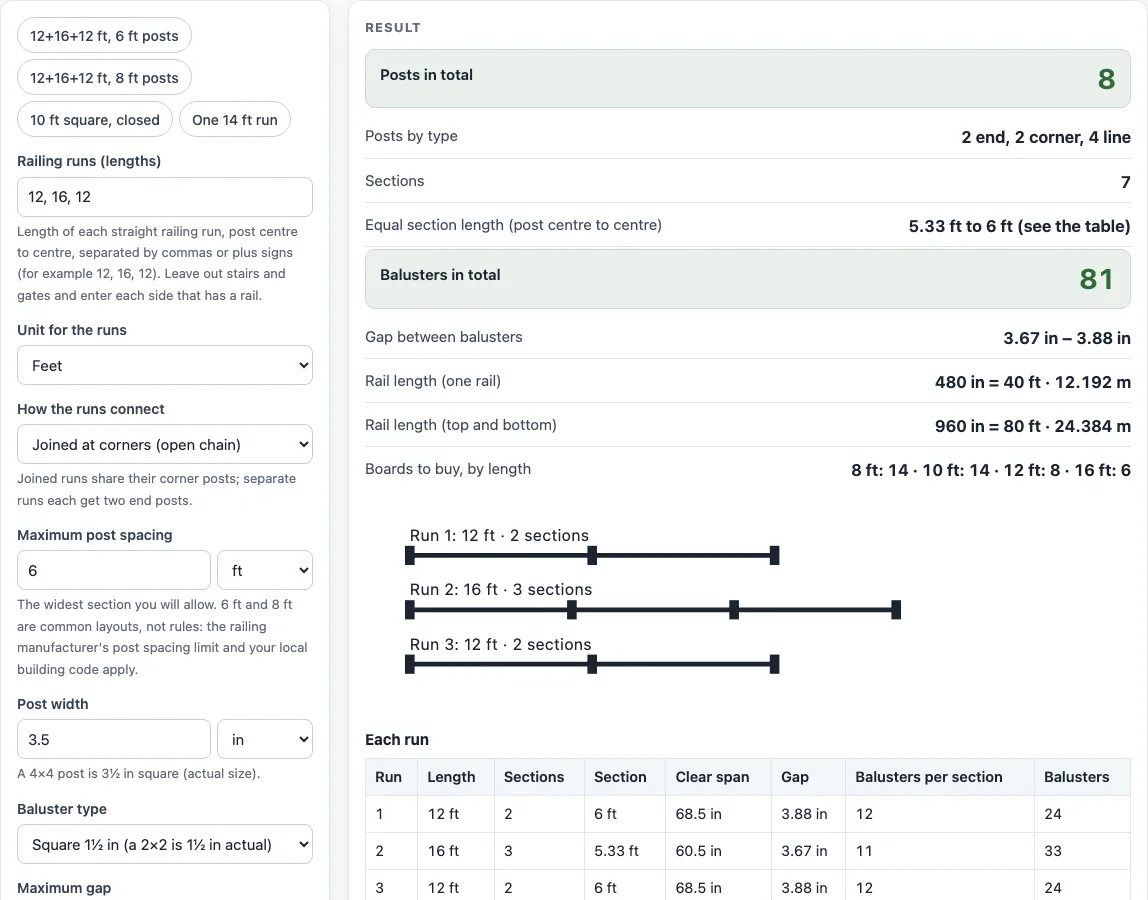
How to use the Deck Railing Calculator
- Click an example button at the top, such as “12+16+12 ft, 6 ft posts”, to load a realistic case. Click “Reset” to return to the starting example.
- In “Railing runs (lengths)”, type each straight run, measured post centre to centre. Separate them with commas or plus signs, for example 12, 16, 12. Leave out stairs and gates.
- Set “Unit for the runs” to Feet, Inches, Metres or Centimetres.
- Choose “How the runs connect”: joined at corners, separate runs, or closed loop.
- Enter your “Maximum post spacing”, the widest section you will allow.
- Enter the “Post width” and choose a “Baluster type”. If you pick “Custom width”, fill in “Baluster width”.
- Enter your “Maximum gap” between balusters.
- Choose “Rails”: top and bottom rail, or top rail only.
- In “Board lengths in stock”, list the rail board lengths you can buy, and set “Unit for board lengths”.
- If you want a cost, choose a “Currency” and enter your own prices for posts, balusters and rail boards, plus the “Board length that price is for”. Nothing is priced unless you enter it.
- Read the result lines, from “Posts in total” down to “Material cost (your prices)”.
Some fields, such as the price inputs, sit under “More options”. “Copy link” keeps all your inputs in the page address, so opening it restores the same result. “Print / save as PDF” prints your inputs, the result, the calculation steps and the date. “How it was calculated” shows each step with your own numbers.
How many posts does a deck railing need?
Each side needs one post at every section end, so posts equal sections plus one. The number of sections on a side is the side length divided by your maximum post spacing, rounded up. Corners are shared between sides when the runs are joined, so you count them once. Separate runs each get two end posts of their own.
For example, a 12 ft run with a 6 ft maximum spacing gives 2 sections and 3 posts. The tool applies the same logic to every run and removes the shared corners.
How far apart should deck railing posts be?
Use the spacing limit from your railing manufacturer. Six and eight feet are common layouts, but they are not rules. The equal section length is the side length divided by the number of sections, so it is always at or below your maximum. A 16 ft run at a 6 ft maximum gives 3 sections of 5 ft 4 in, not 6 ft sections with a short leftover.
If a section is not longer than your post width, the tool shows an error. Check your units and post width in that case.
How many balusters go between deck rail posts?
The clear space in a section is the section length minus the post width. The balusters and the gaps between them have to fill that space, and no gap may be wider than your maximum gap. A common way to find the count is:
Balusters per section = round up of (clear span − maximum gap) ÷ (baluster width + maximum gap)
Take a 6 ft section (72 in) with 3½ in posts. The clear span is 68.5 in. With 1½ in balusters and a 3.75 in maximum gap, the count is 12.33, rounded up to 13. The actual gap is then (68.5 − 13 × 1.5) ÷ 14 = 3.5 in, which is under the limit. The “How it was calculated” list shows these steps with your numbers. If a section is already at or under your maximum gap, no balusters are needed, and the tool says so.
Sources
- 2021 International Residential Code, section R312 (ICC public access) — guards required above 30 in (R312.1.1), 36 in minimum height (R312.1.2), 4-inch sphere and the stair exceptions (R312.1.3). Your state or city may amend these.
- American Softwood Lumber Standard PS 20 (NIST) — dressed sizes of nominal lumber (4×4 = 3½ × 3½ in, 2×2 = 1½ × 1½ in, 1×6 ≈ 5½ in wide).
Worked examples
| Input | Result |
|---|---|
| Runs 12, 16, 12 ft, posts up to 6 ft | 8 posts, 81 balusters, 480 in = 40 ft of rail |
| Runs 10, 10, 10, 10 ft, posts up to 8 ft | 8 posts, 80 balusters, 480 in = 40 ft of rail |
| Runs 14 ft, posts up to 6 ft | 4 posts, 27 balusters, 168 in = 14 ft of rail |
| Runs 3.6, 4.8 m, posts up to 1.8 m | 6 posts, 64 balusters, 8.4 m of rail |
Calculated by the tool above with these values.
Frequently asked questions
Can I use the results for a quote or material list?
Yes. Results may be used in commercial work such as quotes, material lists and job sheets, with no attribution needed. They are estimates for planning and ordering, so check them against your local code and the manufacturer’s instructions before you build.
What if my railing includes stairs or gates?
Leave them out of the run lengths. Enter only the straight runs on each side that has a rail, and plan the openings for stairs and gates separately.
Why does the tool say no balusters are needed?
That warning appears when each section is already at or under your maximum gap. Check the section length and the maximum gap you entered.
How high does a deck railing have to be?
Guards are generally required where a deck is more than 30 in above the ground below (IRC R312.1.1), and residential guards have a minimum height of 36 in (IRC R312.1.2). Your local code sets the final height for your deck.
Does the price include labour or delivery?
The cost only covers the prices you enter for posts, balusters and rail boards. Any other costs, such as labour, delivery or fixings, are not included.
Related tools
- Baluster spacing calculator — balusters per section and the exact gap.
- Stair railing calculator — handrail length, stair angle and balusters.
- Fence picket calculator — pickets, gaps and rails for a picket or privacy fence.
- Fence post concrete calculator — concrete bags per post hole.
- Fence stain calculator — gallons or litres of stain for your fence.
- Fence cost calculator — the materials list and total cost with your local prices.
- Deck post spacing calculator — posts, equal spacing and beam lines for a deck.