Electric Fence Energizer Calculator
Enter the length of your electric fence to get the output joules the energizer needs, or test the one you are buying.
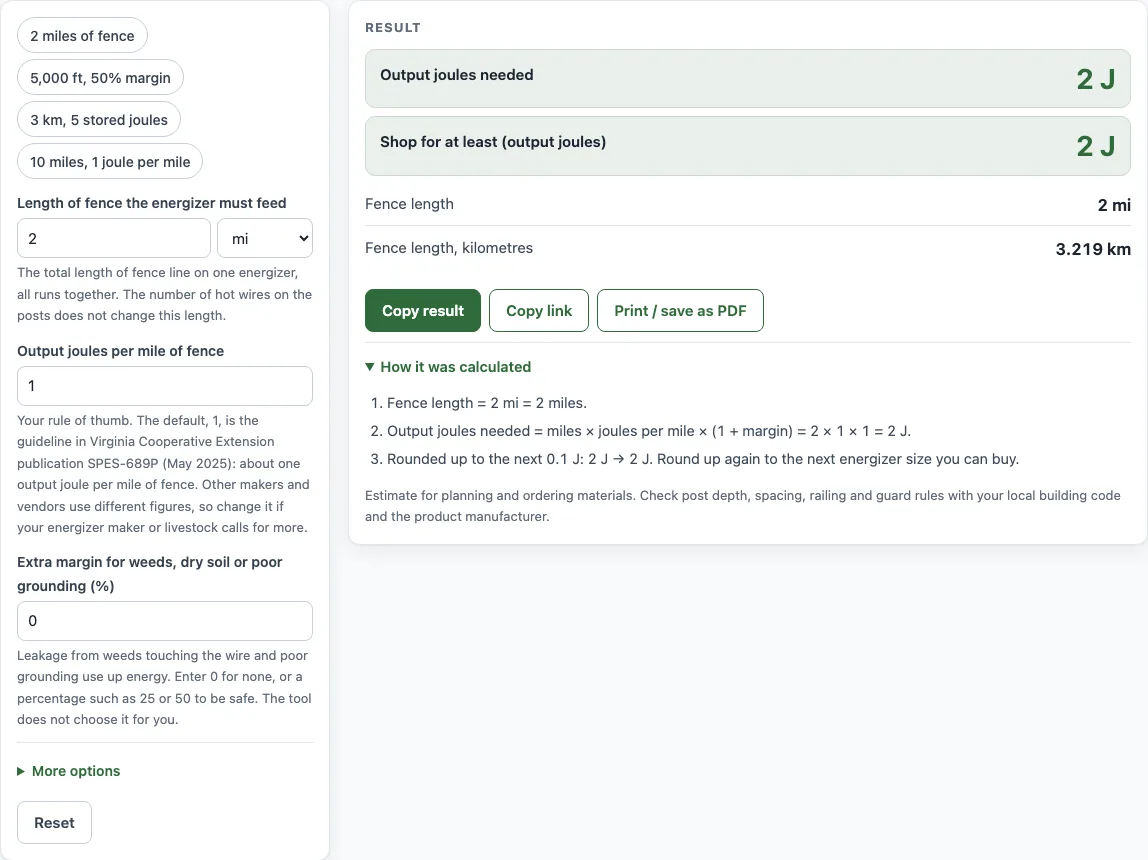
How to use the Electric Fence Energizer Calculator
- Enter the Length of fence the energizer must feed. Add up every run that is joined to the same energizer.
- Leave Output joules per mile of fence at 1, the guideline used by Virginia Cooperative Extension, or type the figure your energizer maker or livestock supplier gives.
- Enter an Extra margin as a percentage if weeds touch the wire, the soil is dry or the grounding is poor. Leave it at 0 for none.
- To test a particular model, open More options, type the joules from its label under Energizer you are looking at, and say whether the figure is Output joules or Stored joules. For stored joules, also enter the output as a percentage of the stored figure.
- Read Output joules needed, Shop for at least, and, for a model you entered, Fence this energizer can feed and Is it big enough?. If the energizer is smaller than the joules needed, a warning says so and shows how much of its rating the fence would use; choose the next size up or shorten the fence.
The example buttons fill in cases such as 2 miles of fence or 5,000 ft, 50% margin. Reset restores the start. Copy result copies the figures, Copy link keeps your inputs in the page address, and Print / save as PDF prints the inputs, the result, the steps and the date.
What size energizer do I need for an electric fence?
Virginia Cooperative Extension publication SPES-689P, “Electric Fencing: How to Select and Install an Energizer” (12 May 2025), gives a guideline of about one output joule for each mile of fence. A two-mile fence therefore calls for an energizer rated at about 2 output joules, and a half-mile paddock for about 0.5. The calculator multiplies your fence length in miles by that figure, and by 1 plus your margin when you add one. For 5,000 ft of fence, which is 0.947 miles, with a 50% margin, that is 0.947 × 1 × 1.5 = 1.42 J, so it suggests shopping for 1.5 J or more. Round up again to the next size that is sold.
Does the number of wires change the joules?
According to the same publication, putting several wires on a fence does not require more joules, as long as all the hot wires are connected to each other at the start and end of each run. For that reason the calculator asks for fence length, not the number of strands. It also notes that connecting the wires lowers resistance and helps the energizer work. Other sellers size from the total wire length instead, so treat this as a starting point and follow your energizer maker’s instructions.
What is the difference between output joules and stored joules?
Stored joules are the energy held in the energizer’s capacitor before it discharges. The energy that actually leaves the transformer is the output joules, and it is always less than the stored figure. The extension publication says the best way to compare energizers is by output joules. If a label shows only stored joules, enter the output share from the data sheet or ask the maker, because the ratio differs between models.
Sources
- Virginia Cooperative Extension, SPES-689P, Electric Fencing: How to Select and Install an Energizer (12 May 2025, read 17 Oct 2026) — about one output joule per mile of fence; more wires do not need more joules if connected at the ends of each run; output joules are always below stored joules and are the best basis for comparing energizers; more joules means more ground rods.
- Needed joules = miles × joules per mile × (1 + margin) — arithmetic on the figures you enter.
Worked examples
| Input | Result |
|---|---|
| 2 mi of fence at 1 J per mile | 2 J needed, shop for 2 J or more |
| 5000 ft of fence at 1 J per mile | 1.42 J needed, shop for 1.5 J or more |
| 3 km of fence at 1 J per mile | 1.86 J needed, shop for 1.9 J or more |
Calculated by the tool above with these values.
Frequently asked questions
How many joules do I need per mile of electric fence?
A good guideline from Virginia Cooperative Extension is about one output joule per mile of fence. Heavy weeds, dry soil or poor grounding can use up energy, so add a margin. Your energizer maker’s instructions come first.
How many joules does a 1-acre or 10-acre paddock need?
The joules follow the length of fence, not the area. Measure the perimeter plus any cross fences on the same energizer, enter it as the length, and read the joules needed. A square 1-acre paddock has a perimeter of about 835 ft, or 0.16 miles, so the guideline gives roughly 0.16 J.
Do more wires mean I need a bigger energizer?
Not under the extension guideline, provided all the hot wires are joined at both ends of each run. Count the length of the fence line, not the strands.
Are stored joules and output joules the same?
No. Stored joules are what the capacitor holds, and output joules are what reaches the fence, which is always less. Compare energizers by output joules.
Is a bigger energizer always better?
A larger energizer gives a margin when weeds or poor soil leak current, and more joules calls for more ground rods. Buying far more than you need costs more, so use the result as a lower bound and the next size up.
Is my fence data uploaded anywhere?
No. The calculator runs in your browser and nothing you type is uploaded. It is free and needs no sign-up.
Related tools
- Barbed wire fence calculator — rolls, posts and braces for a wire fence.
- Split rail fence calculator — rails and posts for a rail fence.
- Fence post spacing calculator — posts and equal spacing for a run.
- Linear feet fence calculator — the length of your fence line in feet, yards and metres.
- Chain link fence calculator — fabric, posts and rails for chain link.
- Pool fence calculator — panels and posts around a pool.