Fence Post Concrete Calculator
Enter the hole size, depth, post size and number of posts to get the concrete volume and bags to buy.
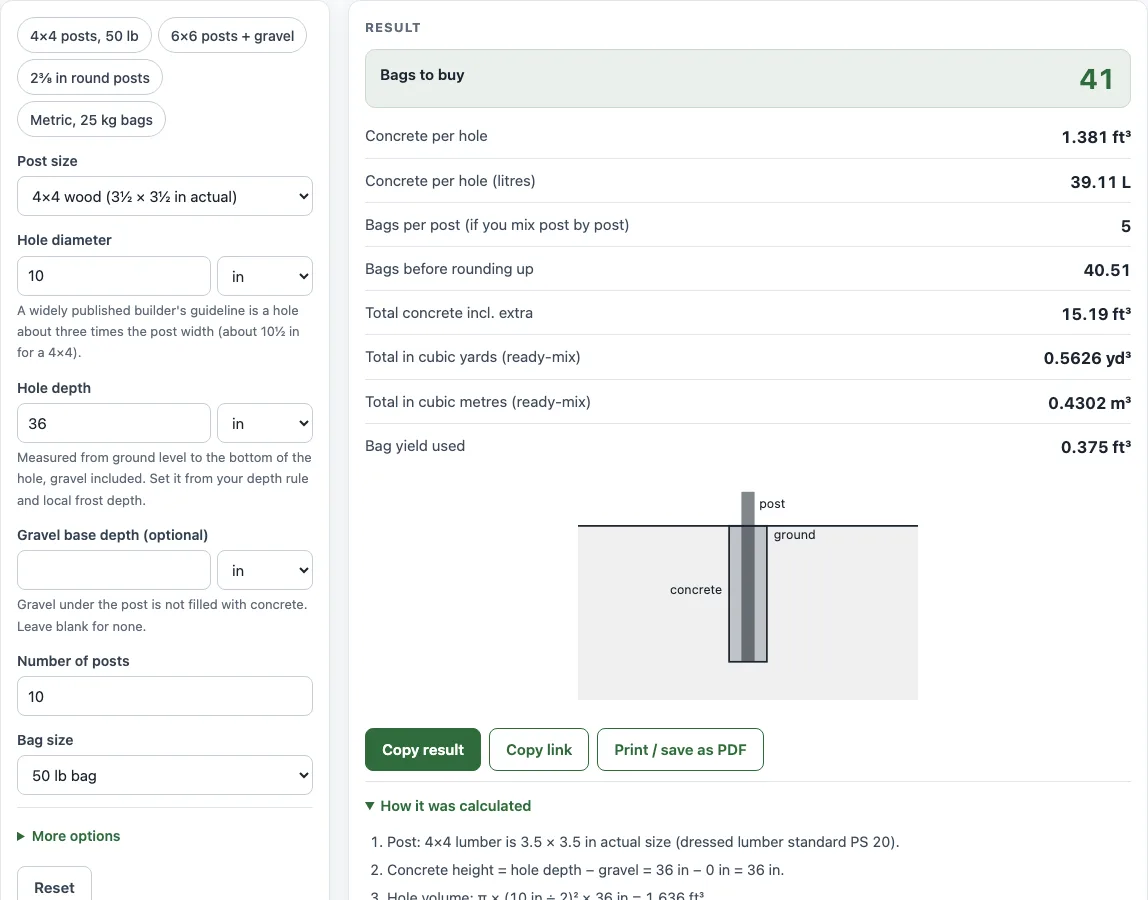
How to use the Fence Post Concrete Calculator
- Start with an example. Click an example button at the top of the form, such as 4×4 posts, 50 lb, to fill in a realistic case. Click Reset to return to the starting example.
- Enter the Hole diameter. The help text suggests about three times the post width, which is about 10½ in for a 4×4.
- Enter the Hole depth, measured from ground level to the bottom of the hole with gravel included. Set it from your depth rule and local frost depth.
- If you use gravel, enter a Gravel base depth (optional). Leave it blank for none.
- Choose a Post size. For round or metal posts, enter the Post outer diameter. For a custom rectangle, enter Post width and Post depth.
- Enter the Number of posts. It must be a whole number.
- Enter Extra for spill and uneven holes (%). Use 0 for the exact volume.
- Choose a Bag size. For lb bags, leave Yield per bag blank. For kg bags, type the yield printed on your bag.
- Read the results: Bags to buy, Bags per post if you mix post by post, and the Total in cubic yards or Total in cubic metres for ready-mix.
- Open How it was calculated to see the formula with your own numbers.
Some fields are under More options.
How much concrete does one fence post need?
The concrete for one hole is the volume of the hole minus the part of the post that sits below ground, minus the gravel layer if you use one. The hole is treated as a cylinder, so its volume is π × radius² × depth, where the radius is half the hole diameter. The post volume is its width times its depth times the buried length. Gravel is not filled with concrete, so its layer is subtracted too.
For example, take a 10 in hole, 36 in deep, with a 4×4 post. A 4×4 measures 3.5 × 3.5 in, not 4 × 4. The hole volume is π × 5² × 36 = 2,827.4 in³. The post takes 3.5 × 3.5 × 36 = 441 in³. The concrete needed is 2,386.4 in³, which is 1.38 ft³ (there are 1,728 in³ in a cubic foot).
How many bags of concrete per fence post do you need?
Divide the concrete per hole by the yield of one bag, then round up to a whole bag. Manufacturers print the yield on the bag. For QUIKRETE Concrete Mix (No. 1101), the data sheet gives about 0.30 ft³ for 40 lb, 0.375 ft³ for 50 lb, 0.45 ft³ for 60 lb and 0.60 ft³ for 80 lb (checked October 2026). Other products, such as fast-setting post mixes, can differ, so always check your bag.
Using the example above, 1.38 ÷ 0.375 = 3.68, which rounds up to 4 bags per post. The tool multiplies by the number of posts to give the total before rounding, then rounds up for Bags to buy. Adding a percentage in the extra field raises the volume before this step.
For a ready-mix order, convert the total to cubic yards (1 yd³ = 27 ft³) or cubic metres (1 m³ = 35.31 ft³). Ready-mix is sold by these units. If the result is large, compare a delivery quote with buying and mixing the bags.
Sources
- QUIKRETE Concrete Mix No. 1101 data sheet — bag yields 0.30 / 0.375 / 0.45 / 0.60 ft³ for 40 / 50 / 60 / 80 lb (checked October 2026).
- American Softwood Lumber Standard PS 20 (NIST) — dressed sizes of nominal lumber (4×4 = 3½ × 3½ in, 2×2 = 1½ × 1½ in, 1×6 ≈ 5½ in wide).
- Unit factors are exact NIST values (SP 811, Appendix B).
Worked examples
| Input | Result |
|---|---|
| 10 × 4×4 posts, 10 in holes 36 in deep, 10% extra | 41 × 50 lb bag (15.2 ft³ = 0.43 m³) |
| 8 × 6×6 posts, 12 in holes 42 in deep, 10% extra | 26 × 80 lb bag (15.2 ft³ = 0.43 m³) |
| 12 × 2.375 in round posts, 8 in holes 30 in deep, 10% extra | 24 × 60 lb bag (10.5 ft³ = 0.297 m³) |
| 10 × 10×10 cm posts, 25 cm holes 90 cm deep, 10% extra | 33 × 25 kg bag (13.7 ft³ = 0.387 m³) |
Calculated by the tool above with these values.
Frequently asked questions
Why does the calculator use 3.5 in instead of 4 in for a 4×4 post?
Nominal lumber sizes are larger than the actual size. A 4×4 measures 3.5 × 3.5 in, and a 6×6 measures 5.5 × 5.5 in. Choosing the right post size keeps the post volume accurate.
What if my post does not fit the hole?
The tool shows an error if the post will not fit. Make the hole wider than the post, measured corner to corner. A rectangular post needs the diagonal to fit within the hole.
Do I need to add extra concrete for spill?
Holes are never perfect cylinders, so an allowance is useful. Enter a percentage in the extra field for spill and uneven holes. Enter 0 for the exact volume.
What yield should I enter for kg bags?
Type the yield printed on your bag, in litres or ft³ per bag. There is no default for kg bags because yields differ by product. For lb bags, the tool uses 0.0075 ft³ per lb unless you type a yield.
Should I mix fast-setting post mix or regular concrete?
Fast-setting post mix is poured dry into the hole, and then water is added. Regular concrete is mixed first. Follow the instructions on the bag.
Can I use these results for a building permit or inspection?
The results are estimates for planning and ordering. Local building codes and the manufacturer’s instructions decide post depth, spacing, railing height and openings. Check those rules before you start work.
Related tools
- Fence cost calculator — the materials list and total cost with your local prices.
- Fence post spacing calculator — the number of posts and an equal spacing.
- Fence picket calculator — pickets, gaps and rails for a picket or privacy fence.
- Fence panel calculator — panels, posts and the cut size of the last panel.
- Chain link fence calculator — the full chain link materials list.
- Fence post depth calculator — how deep to set posts and the post length to buy.