Fence Stain Calculator (Stain Calculator for Fence)
Enter the fence size, sides, coats and the coverage from your can to get how much stain to buy.
The fence stain calculator works out how much stain your fence needs, in gallons or litres, and how many containers to buy. It takes the fence length, height, number of sides, coats and the coverage printed on your can, then shows the area, the stain needed and a container count. It runs in your browser, is free, and needs no sign-up. If you searched for a fence paint calculator or fence paint estimator, the same method works for paint, as long as you use the coverage figure on your paint can.
Results are estimates for planning and ordering. Wood type, dryness and the product all change how much you use, so check the numbers against your can before you buy.
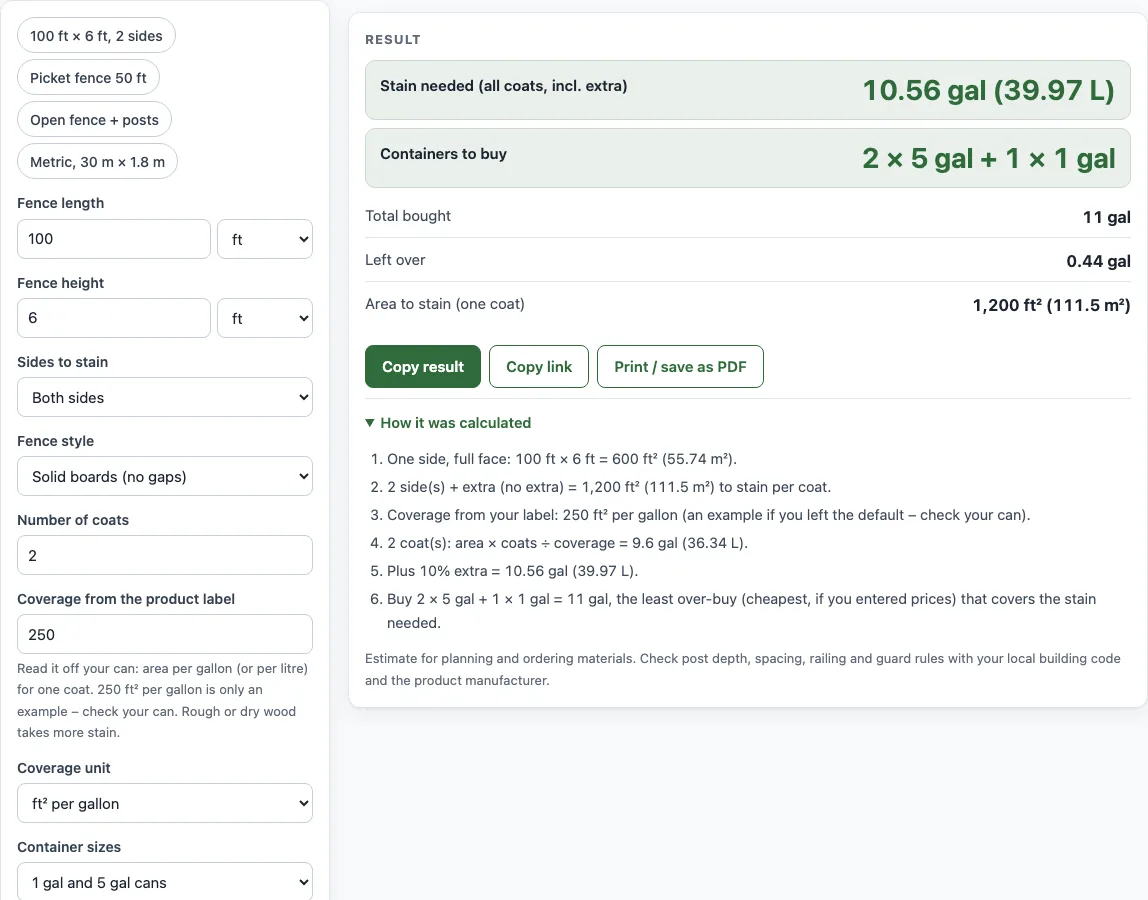
How to use the fence stain calculator
- Enter the Fence length and Fence height in the units you measure in.
- Choose Sides to stain: One side or Both sides.
- Choose a Fence style. Use Solid boards (no gaps) for a solid fence. For a fence with gaps, choose Open – I know the % open and type the figure into Open area (%), or choose Pickets with gaps – enter widths and fill in Picket width and Gap between pickets.
- If you also stain posts, rails, caps or trim, enter their area in Extra area for posts and rails (optional).
- Enter the Number of coats. It must be a whole number.
- Type the Coverage from the product label and pick its Coverage unit. If the label gives a different figure for second coats, enter it in Coverage for later coats (optional).
- Enter Extra for waste and rough spots (%). Use 0 for the exact figure.
- Select your Container sizes. If you want a cost, fill in the price for each size shown and choose a Currency.
The result updates as you type. The example buttons at the top fill in a realistic case, and Reset restores the starting example. Some fields sit under More options.
Under the result, Copy result copies the figures, Copy link keeps all your inputs in the page address, and Print / save as PDF prints the inputs, result, calculation steps and date.
How much stain does a fence need?
Multiply the fence length by its height and by the number of sides to get the area. Then multiply that area by the number of coats and divide by the coverage on your can to get the amount of stain.
For a 100 ft by 6 ft fence stained on both sides, the area is 100 × 6 × 2 = 1,200 ft². With two coats at 250 ft² per gallon, you need 1,200 × 2 ÷ 250 = 9.6 gallons. Two 5-gallon pails cover that, with about 0.4 gallons left over.
The coverage figure on the can is for one coat. Second coats often cover more area than the first, so enter a separate figure if the label gives one. Rough-sawn or very dry wood absorbs more, so add an allowance for waste and thirsty boards if you expect that.
How do gaps between pickets change the amount of stain?
Gaps between pickets mean less wood to stain, so the tool removes the open part of the fence from the area. The open share is gap ÷ (picket width + gap). Picket edges are not counted.
For example, a picket 3.5 inches wide with a 1.5-inch gap is open for 1.5 ÷ (3.5 + 1.5) = 30%. Only 70% of that fence face gets stain, so the area drops by 30%. If you already know the open share, such as a fence that is a quarter gaps, enter it directly as a percentage in Open area (%). The tool only accepts values below 100%.
Should I use more coats or a thicker stain?
Follow the product instructions. Many semi-transparent stains are applied in one or two thin coats, and extra coats that the wood cannot absorb can stay tacky or peel. Solid stains often cover more like paint. Whatever the product, the calculator only multiplies the area by the number of coats you choose and divides by the coverage you enter.
Sources
- Coverage is printed on your product’s label; the 250 ft²/gal default is an example only.
- Unit factors are exact NIST values (SP 811, Appendix B).
Worked examples
| Input | Result |
|---|---|
| 100 ft × 6 ft, 2 sides, solid, 2 coats at 250 ft²/gal | 10.56 gal (39.97 L) → 2 × 5 gal + 1 × 1 gal |
| 50 ft × 4 ft, 1 side, picket, 1 coat at 300 ft²/gal | 0.4242 gal (1.606 L) → 1 × 1 gal |
| 80 ft × 5 ft, 1 side, 25% open, 2 coats at 200 ft²/gal | 3.117 gal (11.8 L) → 4 × 1 gal |
| 30 m × 1.8 m, 2 sides, solid, 2 coats at 8 m²/L | 29.7 L (7.846 gal) → 3 × 10 L |
Calculated by the tool above with these values.
Frequently asked questions
Does the stain calculator work for paint too?
Yes, the same steps apply to paint. Use the coverage figure printed on the paint can, because each product spreads differently.
Why does the result change when I add posts and rails?
Posts, rails and caps add to the area you stain. Enter their total area in Extra area for posts and rails (optional). Leave it blank if you do not stain them.
What if I stain a fence on one side only?
Choose One side under Sides to stain. The area is halved, so the stain amount is halved too, before any extra for waste.
Why does the tool need a whole number of coats?
You cannot apply part of a coat, so the number of coats must be a whole number. If you see the error “Number of coats must be a whole number”, change the value to 1, 2 or 3, for example.
Does the calculator show the cost?
It shows a cost only when you fill in a price for every container size listed. If a price is missing, a warning appears and no cost is shown. Prices are yours, so use local quotes.
Does the calculator know my stain’s coverage?
No. Coverage differs between products and wood, so type the figure printed on your can. The example value only shows how the form works.
Related tools
- Fence cost calculator — the materials list and total cost with your local prices.
- Fence picket calculator — pickets, gaps and rails for a picket or privacy fence.
- Fence panel calculator — panels, posts and the cut size of the last panel.
- Deck railing calculator — posts, balusters and rails for a deck.
- Fence post spacing calculator — the number of posts and an equal spacing.
- Baluster spacing calculator — balusters per section and the exact gap.