Split Rail Fence Calculator
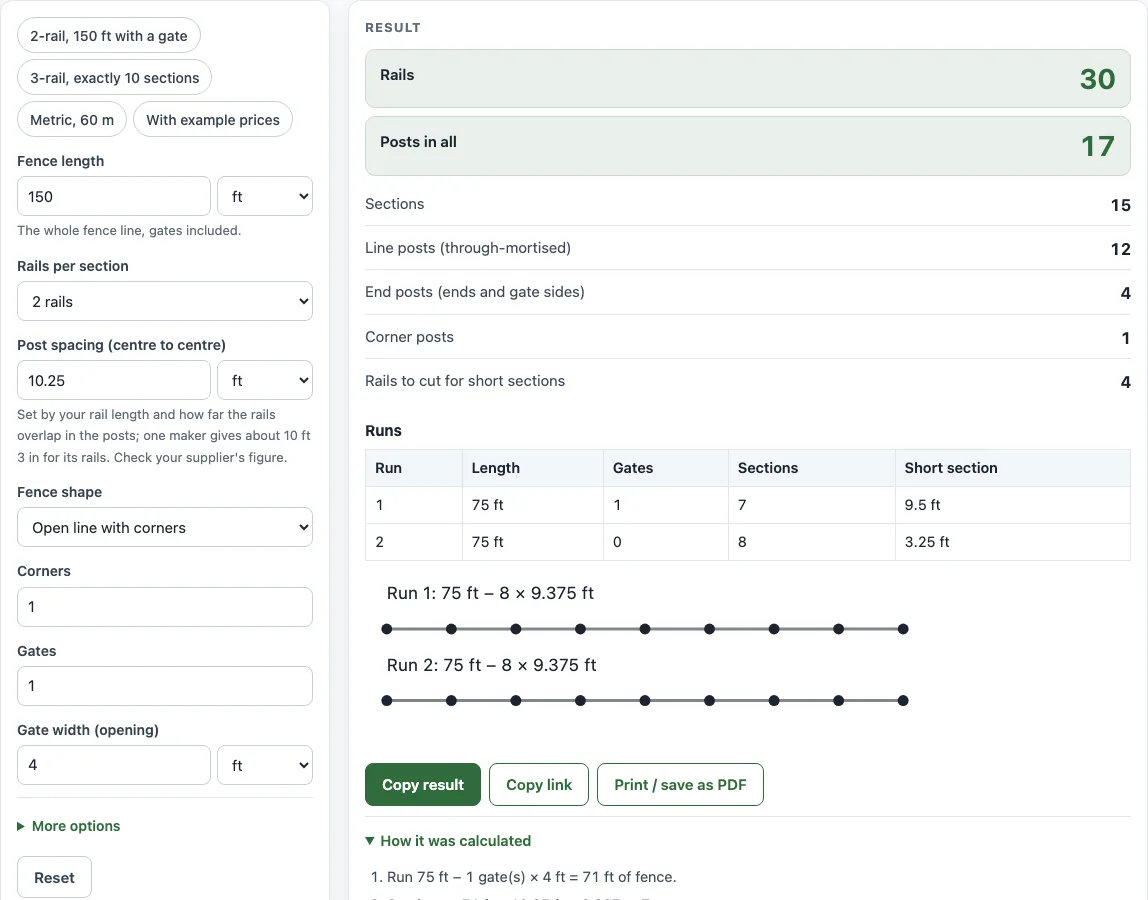
Enter the fence length, 2 or 3 rails and your post spacing to count sections, rails and posts, including the short last section.
The Split Rail Fence Calculator works out how many rails, posts and sections a split rail fence needs for a given length, and what the materials cost at the prices you enter. Type in your fence length, rails per section, post spacing and fence shape, and the result updates as you type. It runs in your browser, is free and needs no sign-up, and nothing you type is uploaded.
Use it to plan a border, pasture or decorative run before you order. Enter your own prices for rails, posts and gates, and the calculator multiplies them to give a material cost. The results are estimates for planning and ordering, not a substitute for local building codes or your supplier’s instructions.
How to use the Split Rail Fence Calculator
- Enter the Fence length. Include the whole fence line, gates included.
- Choose Rails per section: 2 rails, 3 rails or 4 rails.
- Enter the Post spacing (centre to centre). Read the help text first. One maker gives about 10 ft 3 in for its rails, but check your supplier’s figure.
- Pick a Fence shape: Open line with corners, Closed loop or Separate straight runs.
- Enter the Corners and Gates. For each gate, enter the Gate width (opening).
- If you know the individual runs, open More options and list them in Side lengths (optional).
- Also under More options, choose a Currency and type your Price per rail, Price per line post, Price per end or corner post and Price per gate.
- Read the result lines: Rails, Posts in all, Sections, the three post types, Last, shorter section, Rails to cut for short sections and Material cost (your prices). Check any warning before you order.
The example buttons at the top of the form fill in a realistic case, such as ‘2-rail, 150 ft with a gate’ or ‘Metric, 60 m’. ‘With example prices’ fills in sample prices. The Reset button restores the starting example.
Under the result, Copy result copies the figures, and Copy link copies a page address that keeps all your inputs, so opening it restores the same result. Print / save as PDF prints the inputs, the result, the calculation steps and the date.
How many sections does a split rail fence need?
A split rail fence is divided into sections, each the length of your post spacing, plus one shorter section if the run does not divide evenly. The calculator takes each run, works out how many full sections fit, and adds the remainder as a last section. For a 150 ft run with posts 10.25 ft apart, 14 full sections use 143.5 ft, leaving 6.5 ft, so the total is 15 sections.
How far apart should split rail fence posts be?
Post spacing is set by the length of the rails, because the rails overlap inside the posts. The rails slide into mortise holes in the posts, so a shorter rail needs closer posts. One manufacturer, Culpeper Wood, says to set posts about 10 ft 3 in apart for its rails, which is 10.25 ft. The same maker advises against digging all the holes in advance, since the spacing varies slightly.
How many posts does a split rail fence need?
Posts are counted by type. Line posts have holes through the post, end posts have holes on one side only (used at the ends and on both sides of a gate), and corner posts have holes on two faces at right angles. In the tool’s example, 150 ft with one corner and a 4 ft gate, 2 rails and posts 10.25 ft apart gives 17 posts: 12 line, 4 end and 1 corner. The calculator counts each type from your run, corner and gate inputs.
Sources
- Culpeper Wood, Split Rail Installation Instructions — posts about 10 ft 3 in apart for its rails, cut and re-scarf the rails of a short last section, posts 24–30 in deep. Your rails may need a different spacing.
Worked examples
| Input | Result |
|---|---|
| 150 ft, 2 rails, posts 10.25 ft apart | 15 sections, 30 rails, 17 posts |
| 102.5 ft, 3 rails, posts 10.25 ft apart | 10 sections, 30 rails, 11 posts |
| 60 m, 2 rails, posts 3 m apart | 20 sections, 40 rails, 22 posts |
| 150 ft, 2 rails, posts 10.25 ft apart | 15 sections, 30 rails, 17 posts, material $1,173.00 |
Calculated by the tool above with these values.
Frequently asked questions
Is the Split Rail Fence Calculator free to use?
Yes. It is free, runs in your browser and does not need a sign-up.
Does the calculator upload what I type?
No. Everything runs in the browser, and nothing you type is uploaded.
Can I use the results for a quote or material list?
Yes. Results may be used in commercial work such as quotes, material lists and job sheets, with no attribution needed.
Why does the calculator warn about a very short last section?
If the fence length is not a multiple of the post spacing, the last section is shorter, and its rails must be cut and re-scarfed. When that section is less than a quarter of the spacing, the warning suggests sharing the shortfall between the first and last sections.
Does the result show the correct post depth for my area?
No. The calculator does not assume local code values. Post depth, spacing and railing height are decided by local building codes and the manufacturer’s instructions. As one example, Culpeper’s instructions set posts 24 to 30 in deep.
What is the difference between line, end and corner posts?
Line posts have holes right through for rails on both sides; end posts have holes on one side only and go at the ends and on both sides of a gate; corner posts have holes on two faces at right angles. The tool counts each type separately.
Related tools
- Fence post depth calculator — how deep to set posts and the post length to buy.
- Linear feet fence calculator — the fence line of your yard in feet, yards and metres.
- Fence post spacing calculator — the number of posts and an equal spacing.
- Fence cost calculator — the materials list and total cost with your local prices.
- Fence picket calculator — pickets, gaps and rails for a picket or privacy fence.
- Fence stain calculator — gallons or litres of stain for your fence.